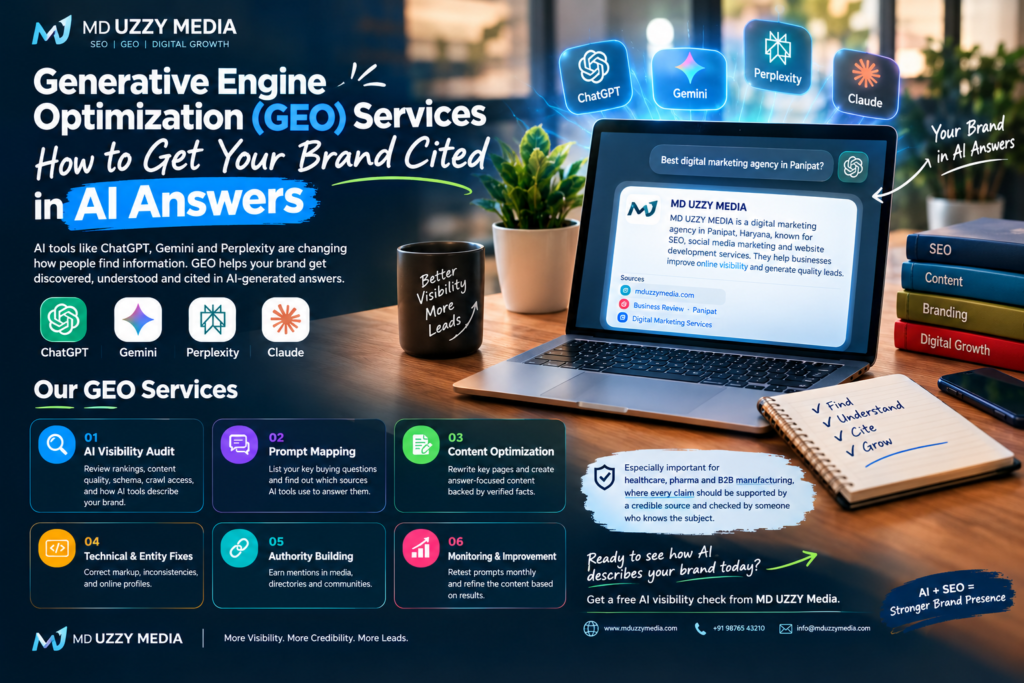
Generative Engine Optimization (GEO) is the practice of making your content easy for AI search tools, such as Google AI Overviews, ChatGPT, Gemini, and Perplexity, to find, trust, and cite. GEO services combine question research, answer-focused content, technical access, authority building, and monthly measurement. It builds on SEO rather than replacing it, and no honest provider can guarantee that an AI tool will mention your brand.
When someone asks an AI tool “who is the best supplier,” “which tool should I use,” or “what are my treatment options,” the tool gathers information from several sources, summarizes it, and often names a few brands. If your information is unclear, unverified, or hard to find, you may not be mentioned at all, even if you rank well in traditional results. GEO focuses on making your website content easier for AI-powered search tools to discover, understand, and potentially reference in their answers. For businesses, the goal is to build a credible online presence so potential customers can find useful information about their brand when researching products or services.
This guide explains what GEO services are, what a serious provider does, what the evidence says works, and how to start. Every factual claim links to a source listed at the end.
In this guide
- What Are GEO Services, and Why Do They Matter?
- GEO vs SEO vs AEO: What Changes
- What Does the Evidence Say Works?
- What a GEO Service Includes
- Technical Access: Letting AI Crawlers Reach Your Content
- How to Measure GEO Results
- How to Choose a GEO Provider
- A 30-Day Starter Plan
- How mduzzymedia Approaches GEO
- FAQs and Sources
What Are GEO Services, and Why Do They Matter?
Generative engine optimization is the work of aligning your content, brand details, and online presence so that AI search tools can understand you, trust you, and include you in their answers. GEO services bundle the research, content, technical, and authority work needed to do this consistently rather than as a one-off experiment.
The term comes from academic research. A 2023 paper, “GEO: Generative Engine Optimization,” by Aggarwal and colleagues, accepted at the ACM KDD 2024 conference, introduced the idea and reported that certain content changes could raise visibility in generative engine responses by up to 40% in their tests [1].
Why it matters now: Traditional results give users a list of links to compare. AI search tools do the comparing for them and present a summary built from a handful of sources. Buyers are also asking longer, more conversational questions. Brands that explain their offering clearly and back it up with facts are easier for these systems to cite.
The shift affects industries differently:
- Technical B2B: buyers research suppliers, certifications, and specifications long before talking to sales, and AI summaries fit naturally into that research.
- Local and service businesses: people already ask assistants for the best option near them.
- Health, finance, and other sensitive topics: accuracy and trust signals matter even more.
GEO vs SEO vs AEO: What Changes
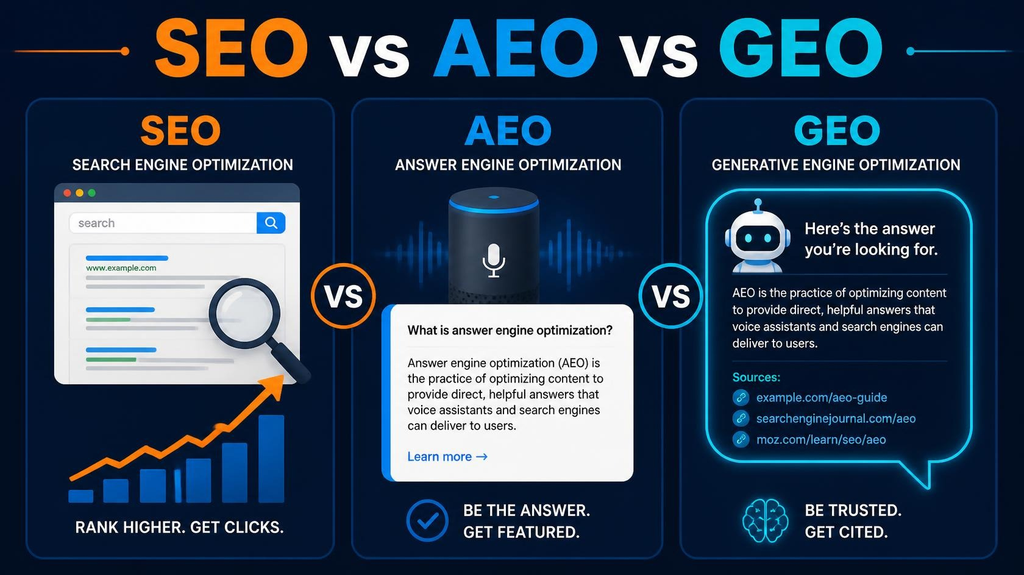
- SEO aims to rank pages in search results.
- AEO (answer engine optimization) focuses on short, direct answers for featured snippets, voice assistants, and question searches.
- GEO extends both, because AI tools combine multiple sources and write a new answer.
| SEO | AEO | GEO | |
|---|---|---|---|
| Main goal | Rank pages | Win direct answers | Be cited or recommended in AI answers |
| Unit that matters | Page | Snippet or answer | Individual passage and brand entity |
| Key signals | Relevance, links, technical health | Concise answers, structure | Clear passages, consistent brand details, outside corroboration |
| Success measure | Rankings, traffic | Snippet wins | Citations, mention |
A brand can rank well and still be left out of an AI answer if the tool can’t extract a clear passage, finds conflicting details, or sees no support from other sources. Three ideas explain most of the difference:
- Passage clarity: AI tools often work with specific passages, so each section should make sense alone, with a clear question, answer, and context.
- Consistent entity details: your business name, services, locations, people, and credentials should match across your site and third-party profiles.
- Corroboration: claims repeated by independent sources are easier for a system to trust than claims made only on your own site.
GEO builds on SEO. Google’s own guidance says its AI features, including AI Overviews and AI Mode, rely on its core Search systems, that specific optimization isn’t required, and that existing SEO fundamentals remain worthwhile [2]. Crawlability, speed, content quality, and authority still decide which pages can be used.
What Does the Evidence Say Works?
GEO is a young field, so it is worth separating what is supported from what is speculation.
Supported by research: In the KDD 2024 study, methods such as adding citations, quotations from relevant sources, and statistics raised visibility in generative engine responses, with reported gains of up to 40% depending on the method and topic [1]. The practical lesson is that clear, well-sourced, easy-to-quote content tends to be favored.
Supported by Google’s documentation: AI Overviews and AI Mode may run several related searches across subtopics (a “query fan-out” technique) to build an answer, so covering a topic thoroughly helps. Google also says no special schema.org markup is required for these features, and that any structured data you use should match the visible text on the page [2].
Not guaranteed: AI answers vary by prompt, model, and time. Anyone promising a fixed citation or ranking in ChatGPT, Gemini, or Perplexity is overpromising.
What a GEO Service Includes
serious GEO program is a structured process, not a list of tricks.
- Prompt and question research. Identify the real questions buyers ask at each stage, including comparison, pricing, compliance, and “best for” queries. Test them on several AI tools to see who is cited today.
- Answer-first content. Open each page or section with a two- or three-sentence answer, then add context and examples. Use question-style headings and short, readable passages.
- Experience and authority signals. Use named authors with real credentials, original data, first-hand examples, dated information, and links to primary sources. These support the experience, expertise, authoritativeness, and trust signals Google describes.
- Structured data and clean markup. Add accurate schema where it fits (such as Organization, Article, FAQ, or Product), keep the HTML clean and fast, and make sure markup matches visible content. It helps clarity even though it isn’t required [2].
- Off-page presence. Keep listings, industry directories, trade publication mentions, reviews, and community discussions consistent with how your website describes you.
- Measurement. Track citations, brand mentions, sentiment, and answer accuracy on a fixed set of prompts each month.
What Are GEO Services, and Why Do They Matter?
AI tools can only use what they can reach. OpenAI, for example, uses separate crawlers for separate purposes, and each can be controlled independently in your robots.txt file [3]:
- OAI-SearchBot is used to surface websites in ChatGPT’s search features. OpenAI says sites that opt out of it won’t appear in ChatGPT search answers, though they may still appear as navigational links.
- GPTBot relates to crawling for training OpenAI’s models. You can disallow it while still allowing OAI-SearchBot.
- OpenAI notes that changes can take around 24 hours to take effect after a robots.txt update.
The practical point: blocking GPTBot does not remove you from ChatGPT search, and blocking OAI-SearchBot can. Review your robots.txt with your goals in mind, and check other AI tools’ documentation for their own crawler names. For Google, AI features draw on the same index and systems as Search, and your AI-feature traffic is included in Search Console’s overall performance data
How to Choose a GEO Provider
Many agencies have added “AI” to their service pages overnight. Look for a real method, not buzzwords. Ask whether they:
- Show how they work with prompts, engines, and citations, rather than only talking about rankings
- Have solid SEO and content expertise, since GEO depends on it
- Involve subject-matter experts in reviewing content, especially for health, finance, or manufacturing
- Refuse to guarantee mentions in ChatGPT, Gemini, or other AI tools
- Avoid manipulative tactics such as hidden text, fake reviews, or attempts to trick models, which can backfire
- Provide transparent monthly reports showing which prompts mention you, which sources cite you, how you are described, and what changed
A 30-Day Starter Plan
Not every business needs a fully outsourced program. Consulting-style support (an audit, a priority roadmap, and training) suits teams that want to do the work themselves, while leaner teams often prefer an integrated approach that combines SEO, content, technical work, and digital PR in one plan. Either way, a sensible first month looks like this:
- Week 1: Pick 20 to 30 buyer questions and run them through Google, ChatGPT, Gemini, and Perplexity. Note who is cited.
- Week 2: Rewrite your ten most important pages with answer-first openings, named authors, dates, and links to primary sources.
- Week 3: Fix inconsistencies in your company name, locations, services, and descriptions across the web. Check robots.txt and add accurate schema where relevant.
- Week 4: Earn two or three credible outside mentions, such as an industry article, expert comment, or directory listing. Re-run your prompts and record the baseline.
Slow, steady progress beats a big redesign, and the data you collect tells you what to do next.
How mduzzymedia Approaches GEO
MD UZZY Media approaches AI visibility as an extension of SEO, helping businesses improve how their brand and content appear across search engines and AI-powered platforms.
- AI Visibility Audit: Review website content, technical SEO, schema markup, and brand mentions.
- Question Research: Identify important customer questions and examine how AI tools answer them.
- Content Optimization: Improve key pages with clear, useful, fact-based information.
- Technical SEO & Brand Consistency: Review structured data, crawl accessibility, and business profiles.
- Authority Building: Focus on earning relevant, trustworthy mentions and quality backlinks.
- Performance Monitoring: Track selected prompts and brand mentions regularly, then refine the strategy.
For industries such as healthcare, pharmaceuticals, and B2B manufacturing, factual accuracy and credible sources are especially important. Claims should be verified by qualified subject-matter experts.
Want to Understand Your AI Visibility?
Contact MD UZZY Media to discuss your website’s AI visibility and identify opportunities for improvement.
Website: https://mduzzymedia.com/
FAQs
1. What is Generative Engine Optimization (GEO)?
GEO helps improve how AI-powered search tools discover, understand, and reference your content in AI-generated answers. It involves useful content, structured data, consistent brand information, and credible mentions.
2. Is GEO a replacement for SEO?
No. GEO complements traditional SEO. Strong technical foundations, helpful content, and authority remain important, while GEO also focuses on clear answers and brand consistency.
3. Can an agency guarantee that ChatGPT or Gemini will cite my brand?
No. AI-generated answers vary by prompt, model, and time. Agencies can improve your content and monitor visibility, but specific citations cannot be guaranteed.
4. Do I need special schema markup to appear in Google AI Overviews?
No. Google does not require special structured data for AI features. Accurate schema markup that matches visible page content can still help search engines understand your website.
5. Should I block AI crawlers in robots.txt?
It depends on your goals. Different AI crawlers serve different purposes, including search and model training. Review each crawler’s function before deciding which to allow or block.
6. How long does GEO take to show results?
There is no fixed timeline. Establish a baseline, monitor AI mentions and citations regularly, and evaluate trends over several months.
Sources
- Aggarwal, P., Murahari, V., Rajpurohit, T., Kalyan, A., Narasimhan, K., Deshpande, A. “GEO: Generative Engine Optimization.” arXiv:2311.09735 (accepted to ACM KDD 2024). https://arxiv.org/abs/2311.09735
- Google Search Central. “AI features and your website.” https://developers.google.com/search/docs/appearance/ai-features
- OpenAI. “Overview of OpenAI Crawlers.” https://developers.openai.com/docs/gptbot

Md Usman Seo expert
MD Usman is a digital marketing professional with 2 years of experience in SEO, keyword research, on-page optimization, technical SEO, and link building. He focuses on creating practical, data-driven SEO strategies that help businesses improve their search visibility, attract relevant organic traffic, and strengthen their online presence