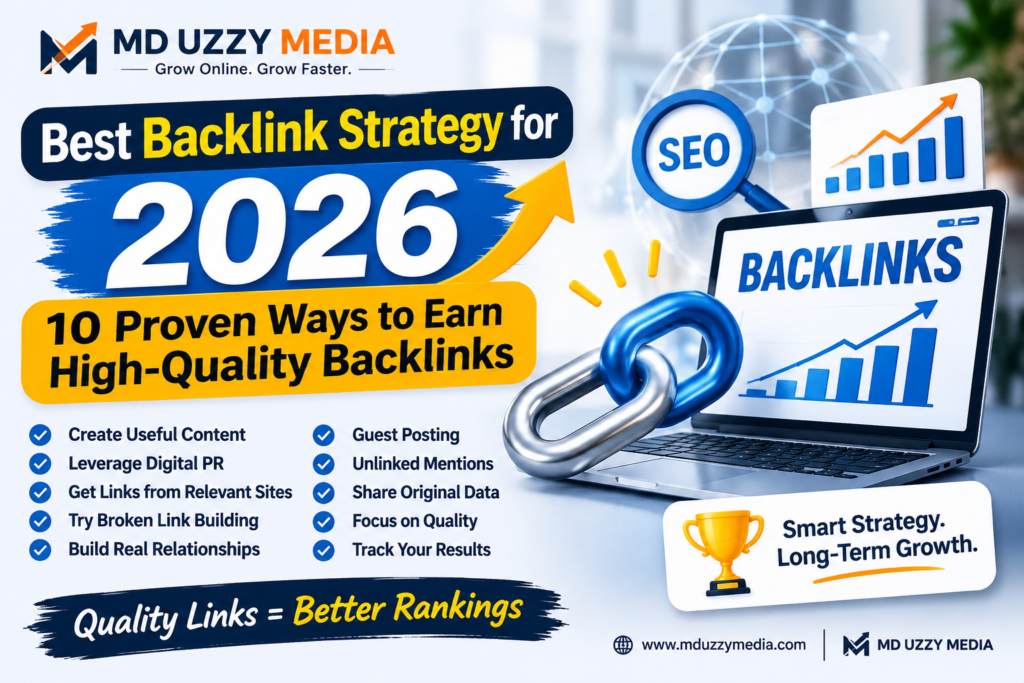
The best backlink strategy in 2026 is to earn a small number of relevant, editorially given links from trusted websites by publishing genuinely useful content, building real relationships, and promoting your work to the right people. Avoid paid links without proper labeling, link exchanges, and mass-produced guest posts. Quality and relevance matter far more than quantity
Ranking on Google takes more than blogging and keyword research. Other websites also need to signal that your content is useful and trustworthy, and backlinks are one of the clearest ways they do that. A backlink can help search engines discover your pages and can send new visitors to your site. But a hundred random links won’t help you the way a handful of relevant, high-quality ones can.
This guide explains what a strong link profile looks like, ten safe methods to build one, the mistakes that can cause penalties, and how to measure results.
In this guide
- What Are High-Quality Backlinks?
- Why Backlinks Still Matter in 2026
- The Best Backlink Strategy for 2026: A Simple Framework
- 10 Proven Backlink Building Methods
- Dofollow, Nofollow, Sponsored, and UGC Links
- Anchor Text: How to Keep It Natural
- Common Backlink Mistakes to Avoid
- A 90-Day Link Building Plan
- How to Check Backlink Quality and Measure Results
- FAQs and Source
What Are High-Quality Backlinks?
A back link is a link from another web page to your website. A backlink to your SEO guide is when a marketing blog links to your guide. Not all backlinks are created equal, though. Those which are helpful and relevant to the website and originate from credible sites are the ones that work for SEO purposes.
| Quality signal | A strong backlink | A weak or risky backlink |
|---|---|---|
| Relevance | The linking page covers a topic related to yours | The page or site has nothing to do with your subject |
| Trust | The site is a reliable source readers know | The site is thin, spammy, or exists only to sell links |
| Placement | The link sits naturally within useful content | The link is hidden in a footer, sidebar, or unrelated text |
| Anchor text | Descriptive and varied | The same exact-match keyword repeated |
| Traffic | The page attracts real readers | The page gets no visitors |
| How it was earned | Given because the content was worth citing | Bought, traded, or created in bulk |
Why Backlinks Still Matter in 2026
Links are still one of the ways search engines find pages and determine which sites other people trust. As AI-generated answers become a part of search, the websites cited and mentioned are often the ones that are already well referenced on the web. Backlinks and mentions from reputable sites can bolster that reputation, but no one outside the search companies knows how much weight each signal carries.
Backlinks help in four main ways:
- Search visibility: relevant links can support rankings, alongside content quality, technical health, and user experience
- Referral traffic: readers click through from other sites to yours
- Brand awareness: being featured in trusted publications puts you in front of new audiences
- Content discovery: links help search engines find your pages
An important caution: backlinks don’t guarantee higher rankings. A great link to a thin, slow, or unhelpful page won’t fix those problems. Content, technical SEO, and user experience are the first things that come to mind.
The Best Backlink Strategy for 2026: A Simple Framework
Most successful link building follows four steps:
- Build something worth linking to. Original research, useful tools, templates, and in-depth guides give people a reason to cite you.
- Find the right people. Identify writers, editors, bloggers, and site owners who cover your topic and already link to similar resources.
- Reach out with value. Tell them briefly why your resource helps their readers. Don’t ask for a link without giving a reason.
- Track and improve. Measure which pages and methods earn links, and do more of what works.
10 Proven Backlink Building Methods
1. Create linkable assets
Content that solves a real problem attracts links naturally. Strong formats include:
- Step-by-step tutorials and in-depth guides
- Original research and statistics
- Free templates, checklists, and calculators
- Case studies with real outcomes
- Comparison charts and clear infographics
For example, a well-made SEO audit checklist is the sort of resource bloggers share with their readers. Strong writing is the foundation here, so invest in depth, accuracy, and clarity.
2. Publish original research and data
Journalists and bloggers constantly look for trustworthy numbers to cite. If you survey your customers or analyze your own data and publish the results, other sites may reference your findings. A digital marketing agency might survey small business owners about their biggest advertising challenges and publish the results with clear charts. Share your method, sample size, and limitations so the data can be trusted.
3. Share expert commentary with journalists (digital PR)
Reporters and editors often need expert input for stories. If you know your field well, respond to relevant media requests, offer quick and specific tips, and be easy to quote. A good answer can earn a mention and a link from a news or industry site, which carries strong credibility.
4. Write guest posts for relevant sites, the right way
Guest posting works when it gives readers real value on a site in your niche. Pitch a specific idea that fits their audience, and link only where it helps the reader. Don’t publish mass-produced guest posts mainly to gain links, because that can be treated as link spam.
5. Try broken link building
Broken link building means finding a dead link on a relevant site and suggesting your page as a replacement. The steps are:
- Find relevant websites in your industry
- Use a tool such as Ahrefs or Semrush to find their broken outbound links
- Check what the missing page used to cover
- Suggest your closest matching, genuinely useful page
It helps the site owner fix a problem, so it often gets a better response than a plain request.
6. Analyze competitors’ backlinks
Use a backlink tool to see which sites link to competitors but not to you. Look for patterns, such as resource pages, industry roundups, or expert quotes, and pursue the best opportunities rather than copying every link.
7. Turn unlinked brand mentions into links
Sometimes a site mentions your business without linking to it. Use Google Alerts or a brand-monitoring tool to find these mentions, then politely ask the author to add a link. Because they already know you, this is one of the easiest ways to earn a quality link.
8. Recover lost backlinks
Links can break when pages are removed, moved, or renamed. Use a backlink tool to find lost links and broken URLs that others still point to. If the old page is still useful, restore it. If not, redirect it to the closest relevant page. This protects traffic and link value you’ve already earned.
9. Get listed in relevant directories and resource pages
Lists, associations, and resource pages in your industry can send both trust and visitors. Choose those that are genuinely relevant and well maintained, and skip mass-submission directories that exist only for links. For local businesses, accurate listings and a complete Google Business Profile also support local SEO.
10. Build partnerships and appear on podcasts and webinars
Collaborating with partners, suppliers, customers, and industry creators often leads to natural links. Speaking on a podcast or webinar usually earns a link in the show notes, and a case study with a client can earn a link from their site.
Dofollow, Nofollow, Sponsored, and UGC Links
Google recognizes several link attributes. It treats them as hints about how to handle a link, rather than strict commands.
| Link type | When it’s used | Why it matters |
|---|---|---|
| Standard (dofollow) | A normal editorial link | Can pass ranking credit |
| rel=”nofollow” | Links you don’t want to vouch for | Generally not used to pass ranking credit |
| rel=”sponsored” | Paid, sponsored, or affiliate links | Required for compensated links |
| rel=”ugc” | Links in user-generated content such as comments and forums | Marks links adde |
A healthy profile includes a mix. Don’t worry if some of your links are nofollow, since they can still bring traffic and credibility.
Anchor Text: How to Keep It Natural
Anchor text is the clickable text of a link. Aim for a natural mix:
- Branded: your business or site name
- URL or generic: your web address, or words like this guide
- Descriptive: a few words that describe the linked page
- Partial or exact match: used sparingly
Repeating the same exact-match keyword across many backlinks looks manipulative. Let other sites choose their own wording wherever possible.
Common Backlink Mistakes to Avoid
- Buying links to boost rankings. Unlabeled paid links violate Google’s spam policies [1].
- Link exchanges at scale. Excessive reciprocal linking done mainly to manipulate rankings can cause problems.
- Chasing quantity. A few strong, relevant links usually beat hundreds of low-quality ones.
- Ignoring relevance. Links from unrelated sites add little value.
- Over-optimized anchor text. Too many identical keyword anchors can look spammy.
- Using automated tools or networks. Automated link building and private blog networks carry high risk.
- Building links to weak pages. Improve the page first so links are worth earning.
- Expecting overnight results. Link building is a long-term effort.
A 90-Day Link Building Plan
| Period | Focus | Actions |
|---|---|---|
| Days 1 to 30 | Foundation | Audit your current backlinks, fix broken pages, improve your best pages, and choose one or two link-worthy assets to create |
| Days 31 to 60 | Outreach | Publish your assets, contact relevant sites with a short personalized pitch, claim unlinked mentions, and start digital PR responses |
| Days 61 to 90 | Scale and review | Add guest posts and partnerships, recover lost links, review what earned links, and double down on those methods |
How to Check Backlink Quality and Measure Results
Track your links regularly:
- Google Search Console: see which sites link to you and check for manual actions
- Ahrefs or Semrush: view referring domains, new and lost links, and competitor gaps
- Google Analytics 4: measure referral traffic and which links send engaged visitors
What to measure:
- Number of new relevant referring domains each month
- Relevance and trust of the sites linking to you
- Whether links sit naturally within content
- Referral traffic and leads from those links
- Changes in organic traffic and rankings for the pages that earned links
About the disavow tool: Most sites don’t need it. Google generally ignores low-quality links automatically. Consider disavowing only if you have a manual action or a clear pattern of paid or spammy links you can’t remove, and do it carefully.
Build Your Link Profile With mduzzymedia
MD UZZY Media helps businesses build quality backlinks through relevant content, ethical outreach, and digital PR strategies. We focus on earning relevant, trustworthy links that support SEO performance and long-term organic growth. Our approach prioritizes relevance, transparency, and sustainable results—without paid-link schemes, spammy tactics, or shortcuts.
- Link audit: review your current backlinks, risks, and opportunities
- Linkable content: create guides, research, and resources worth citing
- Digital PR and outreach: personalized pitching to relevant sites
- Transparent reporting: every link reported with its source, relevance, and attributes
Conclusion
The best backlink strategy for 2026 is not about getting more links. It is about earning the right ones. Create content that deserves to be cited, reach out to relevant people with real value, protect the links you already have, and measure what works. Avoid shortcuts such as paid links without labels, mass guest posting, and link exchanges, because they put your site at risk.
Link building takes patience, and results usually build over months rather than days. Stay consistent, keep quality high, and your link profile will strengthen along with your rankings and brand.
FAQs
What is the best backlink strategy in 2026?
The best backlink strategy is to earn relevant links through useful content, original research, digital PR, and genuine industry relationships. Focus on links that add value to readers rather than chasing large numbers of backlinks. Avoid spammy tactics and manipulative link schemes.
How do I build quality backlinks as a beginner?
Start by publishing useful content that answers real questions in your niche. Reach out to relevant bloggers and website owners, suggest replacements for broken links, and ask publishers to credit your work when they mention your brand without linking to it. Focus on relevance and quality.
Can I get high-quality backlinks for free?
Yes. You can earn backlinks through original research, expert contributions, helpful guest articles, unlinked brand mentions, and genuine partnerships. These methods may require time and consistent effort, but they don’t require buying links.
How many backlinks do I need to rank on Google?
There is no fixed number of backlinks required to rank on Google. The right approach depends on your target keyword, competition, content quality, search intent, and website authority. Analyze competing pages to identify opportunities, but don’t use bac
Md Usman Seo expert
MD Usman is a digital marketing professional with 2 years of experience in SEO, keyword research, on-page optimization, technical SEO, and link building. He focuses on creating practical, data-driven SEO strategies that help businesses improve their search visibility, attract relevant organic traffic, and strengthen their online presence