
You open your analytics dashboard and the numbers look encouraging. Visitors are arriving every day, pages are being viewed, and your rankings seem to be improving. Yet your phone stays silent, your inbox is empty, and your contact form hasn’t been touched in weeks.
If this sounds familiar, you’re not alone. Many businesses in 2026 are investing heavily in digital marketing and still struggle with lead generation. The frustrating part is that more traffic rarely solves the problem. In most cases, the real issue sits somewhere between the visitor arriving and the visitor taking action.
In this guide, you will learn why your website may not be getting inquiries, how SEO and PPC compare for lead generation, and which fixes deliver the biggest improvement first. By the end, you’ll be able to decide which approach suits your business and where your leads are leaking.
Why Is Your Website Not Getting Inquiries?
Before you increase your marketing budget, it’s worth checking the basics. Most websites that fail to generate leads suffer from a combination of these problems:
- The traffic is wrong. Visitors are looking for free information, not a service provider.
- The offer is unclear. People can’t quickly tell what you do or why they should choose you.
- The website is slow or awkward to use, particularly on mobile phones.
- Trust signals are missing. There are no reviews, case studies, or clear business details.
- The next step isn’t obvious. Buttons are weak, hidden, or placed in the wrong spots.
- Nothing is being tracked. Without data, you can’t see where visitors drop off.
SEO vs PPC in 2026: Understanding the Difference
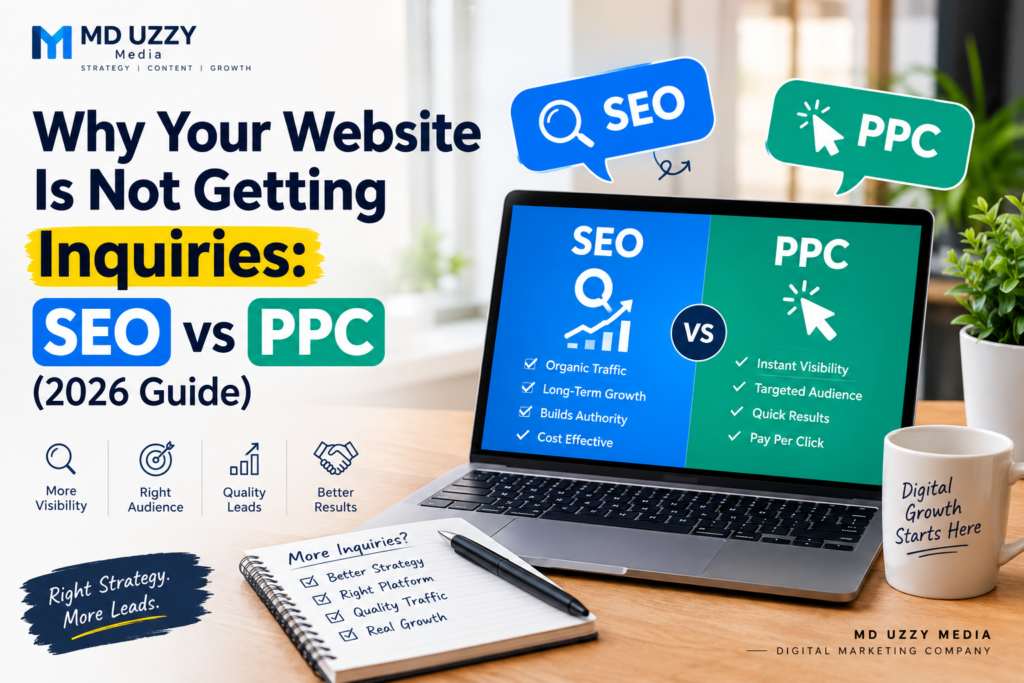
The biggest question businesses ask today is whether to invest in SEO or PPC. Both can bring in leads, but they work in very different ways.
What Is SEO? Search engine optimization improves your website so it can appear in organic (unpaid) search results. It involves keyword research, useful content, on-page improvements, technical health, and building authority over time. The results take longer to appear, but they tend to build on one another and continue working without paying for each click.
What Is PPC? Pay-per-click advertising places your ads in front of people who are actively searching or browsing. Platforms like Google Ads let you target specific keywords, locations, and audiences. The results can arrive within days, but your visibility lasts only as long as your budget does.
SEO vs PPC at a Glance
| Factor | SEO | PPC |
|---|---|---|
| Speed of results | Gradual, often several months | Fast, sometimes within days |
| Cost structure | Ongoing work and optimization | Pay for every click |
| Long-term value | Builds over time | Stops when the budget stops |
| Best for | Authority and steady leads | Launches, offers, and quick testing |
| Control over targeting | Moderate | High |
| Risk | Slow start | Wasted spend if poorly managed |
Which Is Better for Lead Generation?
SEO is better for businesses that want long-term, steady growth. PPC is better for businesses that need immediate exposure, such as a new launch or a time-limited offer. Neither will rescue a website that fails to convince visitors, which is why fixing conversion problems should come first.
Why Your SEO May Not Be Producing Leads
Many businesses spend months on SEO and still don’t see the enquiries they expected. Here are the most common reasons.
Targeting Keywords With High Traffic but Low Intent
A keyword with thousands of monthly searches looks attractive, but it doesn’t always bring buyers. Someone searching “what is digital marketing” is usually learning, while someone searching “digital marketing agency for small business” is much closer to making a decision.
How to fix it: Build your main service pages around commercial and local keywords, such as phrases containing “services,” “agency,” “company,” “pricing,” or “near me.” Use informational blog posts to support these pages and guide readers toward them.
Ignoring On-Page Optimization
Weak page titles, thin service pages, missing headings, and poor internal linking make it harder for both search engines and visitors to understand what you offer. Often a handful of on-page improvements can lift performance noticeably.
How to fix it: Give every important service its own page. Write a clear title and heading, explain the service in useful detail, answer common questions, and link to related pages
Not Optimizing for Mobile Users
Most people now search on their phones. If your pages load slowly, the text is tiny, or the buttons are hard to tap, visitors will leave before contacting you.
How to fix it: Open your site on a real phone and try to complete an enquiry yourself. Compress large images, simplify layouts, and make call and contact buttons easy to reach with a thumb.
Why Your Google Ads Are Not Giving Results
If you’re paying for clicks but not receiving inquiries, the issue is usually one of the following.
Poor Audience Targeting
Broad keywords and wrong locations quickly drain your budget. If you run a service in one city but show ads across the country, most clicks will never become customers.
How to fix it: Use specific keywords, add negative keywords to block irrelevant searches, and target the exact locations and audiences you serve.
Weak Ad Copy
Generic lines like “Best Services, Call Now” look the same as every other ad. They give people no reason to click.
How to fix it: Mention a real benefit, a service area, a result, or an offer. Make it clear who the ad is for and what happens after the click.
No Clear Offer
People are more likely to respond when the next step feels easy and valuable. If your ad and page simply say “contact us,” many visitors will hesitate.
How to fix it: Offer something specific, such as a free consultation, a free website audit, or a no-obligation quote.
Sending Ad Traffic to the Wrong Page
Many businesses send paid traffic to their homepage, where visitors must hunt for the information they need. This is one of the most common reasons ads underperform.
How to fix it: Send each ad to a landing page that matches its message, with one clear action.
No Conversion Tracking
If you don’t track calls, form submissions, and chats, you can’t tell which keywords or ads produce leads and which only produce clicks.
How to fix it: Set up conversion tracking in Google Ads and Google Analytics so every decision is based on real results.
Why Your Website Is Not Converting Visitors Into Leads
Sometimes traffic and ads are fine, and the real problem is the experience people have once they arrive. Three issues come up again and again.
1. A Poor User Experience
Crowded layouts, intrusive pop-ups, long forms, confusing menus, and slow pages all create friction. Every extra step between a visitor and your contact form is a chance for them to leave. Review your website as if you were a first-time visitor and remove anything that gets in the way.
2. A Lack of Trust
People don’t contact businesses they can’t verify. Visitors want reassurance that you are real, reliable, and experienced. You can build trust by adding:
- Genuine customer reviews and testimonials
- Case studies showing actual results
- A phone number, email address, and business address
- An honest About page with real people and photos
- Certifications, partnerships, or client logos, where you have permission to display them
How to Generate Leads From Your Website in 2026
Once you’ve fixed the basics, these steps can help your website start working as a lead generation tool.
1. Create optimized landing pages. Build dedicated pages for each service or campaign instead of sending everyone to a general page. Each page should match a specific search or ad.
2. Place calls to action strategically. Put a button near the top of the page, another after your main benefits, and a final one at the end. On mobile, add a tap-to-call button that stays visible.
3. Use lead magnets. A free consultation, audit, checklist, or short guide gives visitors a low-risk first step and gives you a way to follow up.
4. Keep your forms short. Asking for a name, a phone number or email, and a brief message is often enough. Every additional field reduces the chance of completion.
5. Offer quick contact options. Many visitors prefer WhatsApp or live chat to filling in a form.
6. Respond fast. The business that replies first often wins the customer. Set up notifications so you can reply to enquiries within minutes during working hours.
7. Track and review your results. Measure form submissions, calls, and chats. Check which pages and sources produce leads, and improve those first.
SEO vs PPC for Small Businesses
For small businesses, cost and return on investment matter most. You can’t afford to waste budget, so the right mix depends on your goals and timeline.
Choose SEO for Steady Traffic
If you have a modest budget and can wait a few months, SEO can provide a dependable flow of visitors with a lower cost per lead over time. It is especially valuable for local service businesses, where people search for solutions in their own area.
Choose PPC for Quick Tests and Quick Leads
If you’re launching something new, running a seasonal promotion, or want fast feedback, PPC puts you in front of customers almost immediately. It also shows you which keywords, offers, and messages generate enquiries.
Combine SEO and PPC for the Highest ROI
When budget allows, using both gives the strongest results. PPC reveals what converts quickly, and SEO then builds lasting visibility around those same topics. A simple plan looks like this:
- Run a small PPC test to find high-converting keywords and offers.
- Improve your landing pages using what you learn.
- Build SEO content and service pages around the best-performing topics.
- Gradually shift budget as organic leads grow.
Why Work With a Digital Marketing Agency in Panipat?
If your strategy has gaps and you don’t have the time, skills, or tools to close them, a digital marketing agency in Panipat can help you build systems that work. The right agency should offer: Data-driven strategies Decisions based on your numbers, not guesses or generic templates. Conversion-focused design Websites and landing pages built to turn visitors into enquiries, not just to look good. Advanced tools and analytics Proper tracking, clear dashboards, and reports you can understand, Honest timelines. A realistic view of when results should appear, with no promise of instant rankings.
Frequently Asked Questions
Why does my website get visitors but no inquiries?
Usually it comes down to low-intent traffic, an unclear offer, a slow or untrustworthy page, or weak calls to action. Review these before increasing your budget.
Is SEO or PPC better for small businesses?
SEO suits long-term, cost-efficient growth, while PPC suits quick results and testing. Many small businesses start with PPC for early data and build SEO alongside it.
How long does SEO take to generate leads?
It depends on competition and the condition of your website, but most businesses should expect a few months before seeing steady gains.
Why aren’t my Google Ads converting?
The most common causes are broad targeting, generic ad copy, no clear offer, a mismatched landing page, and missing conversion tracking.
What can I fix first to get more inquiries?
Start with your offer, your mobile experience, and your calls to action. These changes are often quick and can make a visible difference.
Conclusion: What Should You Choose in 2026?
If your website isn’t generating leads, the issue is not just traffic. It’s strategy, clarity, trust, and experience working together.
- SEO builds long-term authority and steady organic leads.
- PPC brings instant results and valuable data.
- A combination of both delivers the best outcome, supported by a website that’s built to convert.
Begin with the fundamentals: a clear offer, a fast mobile experience, visible trust signals, and strong calls to action. Then use SEO and PPC to bring more of the right visitors to a website that is ready to turn them into customers.
Ready to Turn Your Visitors Into Inquiries?
If you’re looking to grow your business with SEO services for small businesses or need expert lead generation services, Md Uzzy Media can help you scale faster.
 Contact mduzzymedia.com today for a free consultation.

MD Usman is a digital marketing professional with 2 years of experience in SEO, keyword research, on-page optimization, technical SEO, and link building. He focuses on creating practical, data-driven SEO strategies that help businesses improve their search visibility, attract relevant organic traffic, and strengthen their online presence
MD USMAN
SEO EXPERT