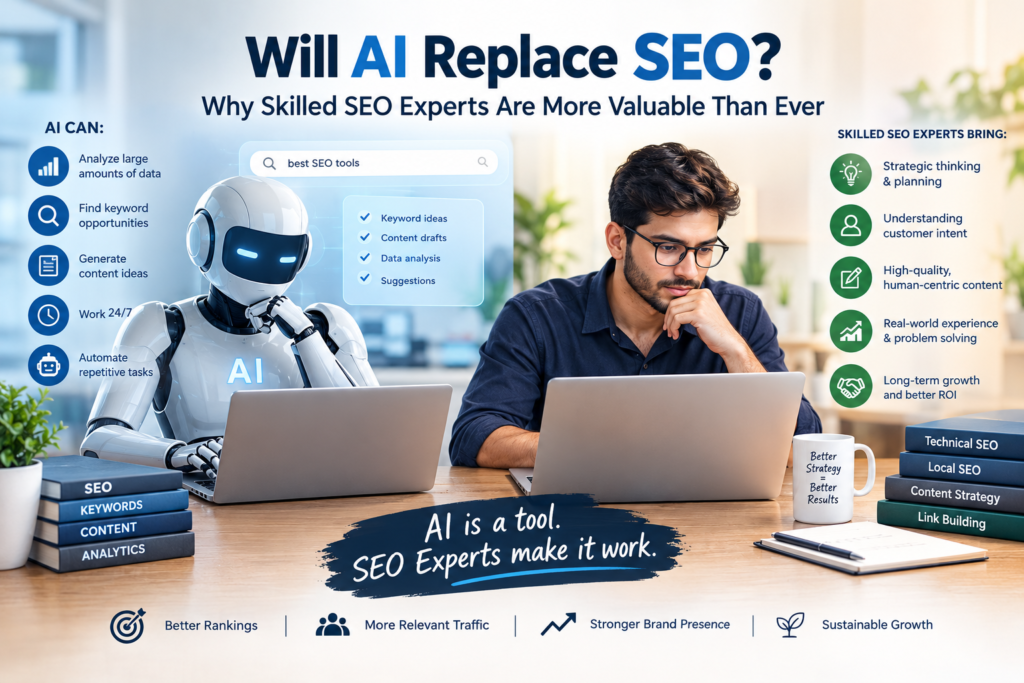
AI in digital marketing helps businesses save time, improve campaign performance, and make data-driven decisions. For example, a digital marketing agency running an advertising campaign to generate more client enquiries can use AI to analyze audience behavior, identify common customer questions, create ad copy variations, and explore targeting strategies SEO services agency can use AI tools for keyword research, search intent analysis, content planning, and competitor research.
No. AI is not replacing the strategy, judgment and customer understanding that earn rankings, but it is replacing repetitive SEO tasks such as keyword grouping, first drafts and reporting. SEO is changing, not disappearing.
AI tools can now research keywords, draft meta descriptions, outline articles, and summarize performance data in minutes. So it’s fair to ask: will AI replace SEO as businesses adopt more automation? Not really. AI can speed up many SEO tasks, but it can’t guarantee rankings, leads, or sales. Businesses still need people who understand their audience, check the facts, and decide what to do with the data AI produces.
That’s why a popular saying has emerged: AI won’t replace SEO professionals, but SEO professionals who use AI well may replace those who don’t. The question isn’t if AI can do SEO. It’s about how AI is transforming the job, the skills that are becoming more valuable, and what to do about it.
Table Of Content
- How AI Is Changing SEO
- How Search Itself Is Changing
- What Can SEO Experts Do That AI Cannot Easily Replace?
- Will AI Replace SEO Jobs by 2030?
- How AI and SEO Experts Can Improve Rankings Together
- Best AI Tools for SEO in 2026
- Why Using AI Does Not Always Improve Rankings
- Skills Future SEO Professionals Should Learn
- Conclusion and FAQs
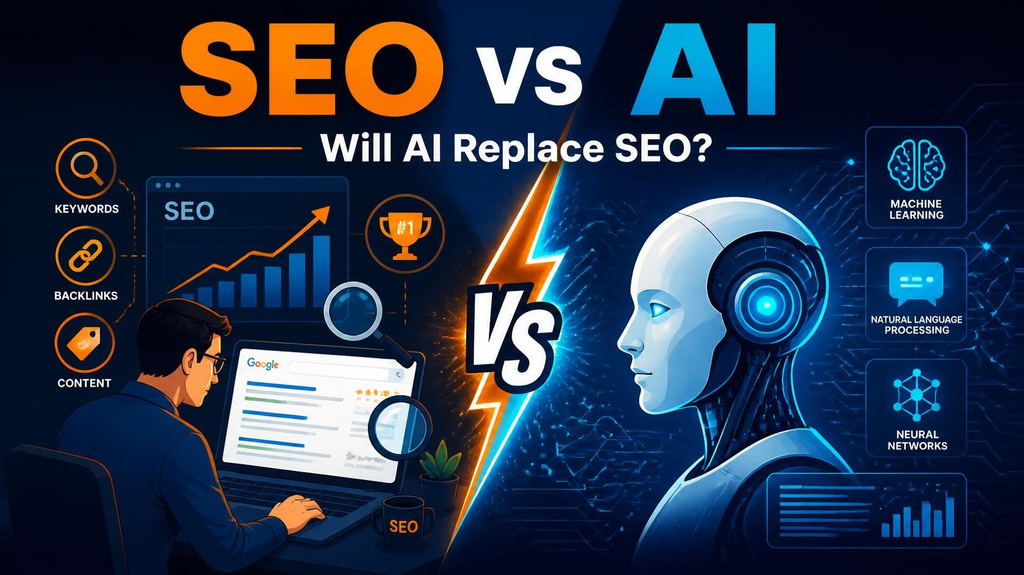
1.How AI Is Changing SEO
search engine optimization (SEO) is the process of optimizing a website to rank for the keywords that customers are searching for. That includes keyword research, content, technical optimization, link building, and tracking results, and all of these require time. Some of it can be done much faster with
AI.Today, AI can help with:
- Keyword research: grouping thousands of keywords by topic and intent
- Content support: outlines, first drafts, and rewrites of titles and meta descriptions
- Technical checks: flagging broken links, missing tags, and duplicate pages
- Reporting: summarizing traffic and ranking changes in plain language
For example, an online clothing store may want pages for college students, working professionals, and wedding shoppers. AI can sort search terms into those groups and draft page outlines quickly.
But AI is only as good as the data and direction it receives. If your analytics are incomplete or your goals are unclear, it can suggest keywords that bring traffic but no customers. AI works best when it supports good data and real SEO skill.
How Search Itself Is Changing
AI isn’t only a tool for SEO. It is also changing search. Google now shows AI-generated summaries on many results pages, and people increasingly ask questions in AI assistants such as ChatGPT. This means being found now includes being cited as a source in these answers, not just ranking in the blue links.
This doesn’t make SEO obsolete. It raises the bar. AI systems tend to draw from pages that give clear, accurate, well-structured answers from trustworthy sources. The fundamentals still decide who gets seen:
- Content that answers real questions directly
- Clear headings, tables, and FAQs that are easy to quote
- Evidence of real experience and expertise
- A fast, mobile-friendly, crawlable website
Some people call this “GEO” (generative engine optimization) or “AEO” (answer engine optimization). In practice, it is good SEO applied to a wider set of places where answers appear.
What Can SEO Experts Do That AI Cannot Easily Replace?
SEO is about understanding why people search and what makes them act. Consider a wedding venue that wants more enquiries during the wedding season. AI can suggest pages about decoration, catering, and packages.
But customers have specific worries. One family cares about parking, another about guest rooms, another about space for a large gathering. A skilled SEO professional learns this by talking to the sales team, reading past enquiries, and studying what visitors ask. Then they build pages that answer those real questions.
Human judgment also matters when something goes wrong. Imagine a page that ranks well and brings steady traffic but few enquiries. The cause could be a confusing form, unclear pricing, or an offer that doesn’t match what searchers expected. AI can help analyze the data, but a person has to decide which problem is the real one and what to change.
That is why strategy, creativity, customer understanding, and decision-making remain valuable SEO skills.
1.Will AI Replace SEO Jobs by 2030?
AI is changing SEO jobs by handling routine work such as basic content drafts, simple audits, and standard reports. That doesn’t mean every SEO role will disappear.
The World Economic Forum’s Future of Jobs Report 2025 projects that about 170 million jobs could be created globally by 2030, while about 92 million could be displaced. These figures cover the whole job market and reflect many economic and technology shifts, not AI alone. The report also points to rising demand for technology skills, creative thinking, and problem-solving.
For SEO, this suggests the work will evolve. Someone who only does basic, repetitive tasks may face more competition from automation. Someone who understands search, uses AI to work faster, and can turn data into better results gives a business far more value. Continuous learning is now part of the job.
2.How AI and SEO Experts Can Improve Rankings Together
AI saves time, but people still make the important decisions. Here is a simple, hypothetical example.
A digital marketing agency wants to generate more client enquiries through its website. AI can group relevant search queries, suggest service page topics, and draft content outlines. The SEO specialist then checks that the service details, pricing, and claims are accurate before anything is published.
Suppose the agency publishes two pages:
- Page A (a general blog post) gets 3,000 visits and 6 enquiries, a 0.2% enquiry rate.
- Page B (a digital marketing services comparison page) gets 600 visits and 18 enquiries, a 3% enquiry rate.
More traffic doesn’t always mean more success. AI can compare these numbers quickly, but an SEO professional needs to understand why Page B converts better. Perhaps it matches customer intent more closely or answers the questions potential clients have before choosing an agency.
That insight can then be applied to other service pages. This is how AI and SEO experts work together to improve marketing performance.
3.Best AI Tools for SEO in 2026
Different tools suit different jobs. Here are common choices:
| Tool | What it helps with |
|---|---|
| ChatGPT | Content ideas, outlines, first drafts, and summarizing data |
| Google Search Console | Seeing which queries and pages bring clicks and impressions |
| Google Analytics 4 | Understanding visitor behavior and conversions |
| Ahrefs or Semrush | Keyword research, competitor analysis, and backlink data |
| Screaming Frog | Crawling a site to find technical issues |
| Canva | Creating blog graphics and social images |
A content writer might lean on ChatGPT, while a technical SEO relies more on a crawler and Search Console. Choose tools based on your role instead of trying to learn every tool at once.
4.Why Using AI Does Not Always Improve Rankings
AI can produce huge amounts of content in a short time, but more content doesn’t guarantee better rankings. A site with 30 articles that repeat the same points and answer nothing new is unlikely to help readers or search engines.
Google has said that using AI to help create content is not against its guidelines by itself. However, producing large volumes of low-value pages mainly to manipulate rankings can violate its spam policies. Google’s guidance keeps pointing back to helpful, accurate, people-first content.
There is also the risk of misinformation. AI can invent facts, statistics, or product claims that a business can’t back up. That can harm trust and your reputation.
So before publishing AI-assisted content, SEO professionals should:
- Verify every fact, number, and claim
- Add original insight, examples, or first-hand experience
- Protect customer and company data when using AI tools
- Edit for clarity, tone, and usefulness
Skills Future SEO Professionals Should Learn
As AI continues to change digital marketing, SEO professionals need strong fundamentals alongside modern skills:
- Search Intent: Understanding what users expect when they search online.
- Technical SEO: Improving website speed, crawlability, indexing, and site structure.
- Content Strategy: Creating helpful, original, and trustworthy content that meets audience needs.
- Data Analysis: Using traffic, ranking, and conversion data to identify opportunities.
- AI Tools: Using AI for research, content planning, and reporting while checking accuracy and quality.
- Communication: Explaining SEO performance and recommendations in clear business terms.
Practical experience matters most. Beginners can start with a small website, research keywords, publish useful content, and monitor performance through Google Search Console. Testing different approaches helps build real-world experience and shows how AI can support effective SEO.
Why Work With mduzzymedia?
MD UZZY Media combines SEO strategies with practical AI tools to help businesses improve search visibility, attract relevant organic traffic, and generate potential leads.
- SEO Expertise: We focus on keyword research, technical SEO, local SEO, and content optimization to improve online visibility.
- Human-Reviewed Content: We use AI to support research and planning, while prioritizing accuracy, relevance, and useful content.
- Customized Strategies: Every SEO strategy is shaped around business goals, target audiences, competition, and search intent.
- Data-Driven Reporting: We monitor organic traffic, keyword performance, website enquiries, and conversions to identify opportunities for improvement.
- Long-Term Growth: Our approach emphasizes sustainable SEO practices, consistent optimization, and a better user experience.
Conclusion
So, is AI taking the place of SEO? AI will take over some routine tasks, and the way people search is changing. However, there will still be a need for businesses to have skilled individuals who can understand their customers, produce trustworthy content, resolve technical issues, and make decisions based on results. AI can help save time, organize information, and do repetitive work. People are still the source of strategy, accuracy and customer understanding. There will be some SEO tasks that will be automated and new skills will be required. Those who adapt will be well placed for what’s ahead. Ultimately, AI is not a magic bullet for becoming a better SEO. The key to success lies in understanding how to leverage AI alongside solid SEO principles.
FAQs
Is there a future for SEO without AI?
Yes. SEO can still be done without AI. Understanding search intent, creating helpful content, and fixing technical issues remain important. AI can make some tasks faster, but it is not a requirement for every SEO activity.
Is SEO still worth it in 2026?
Yes. SEO helps businesses improve organic visibility, attract relevant visitors, and reach people searching for their products or services. Results depend on competition, content quality, and execution.
Can AI replace SEO experts and content writers?
AI can assist with keyword research, content drafts, and reporting. Human expertise remains valuable for strategy, fact-checking, technical problem-solving, and understanding customer needs.
What are the best AI skills for SEO professionals?
Learn prompt writing, AI content verification, keyword research, search data analysis, and AI-assisted content planning. Focus on using these skills to solve real marketing problems.
Can I learn AI for SEO without coding?
Yes. Beginners can use tools such as ChatGPT, Google Search Console, and Canva without coding. Start with keyword research, content outlines, and performance tracking before exploring advanced automation.
Md Usman Seo expert
MD Usman is a digital marketing professional with 2 years of experience in SEO, keyword research, on-page optimization, technical SEO, and link building. He focuses on creating practical, data-driven SEO strategies that help businesses improve their search visibility, attract relevant organic traffic, and strengthen their online presence